On a Sunday morning in June, the inventor of the Temporal-Awareness patent family asked Google's flagship AI to do something a wristwatch has done since 1977: remind him about something ten minutes from now. What happened next is the clearest live demonstration available of why architecturally non-temporally-aware AI cannot do this job.
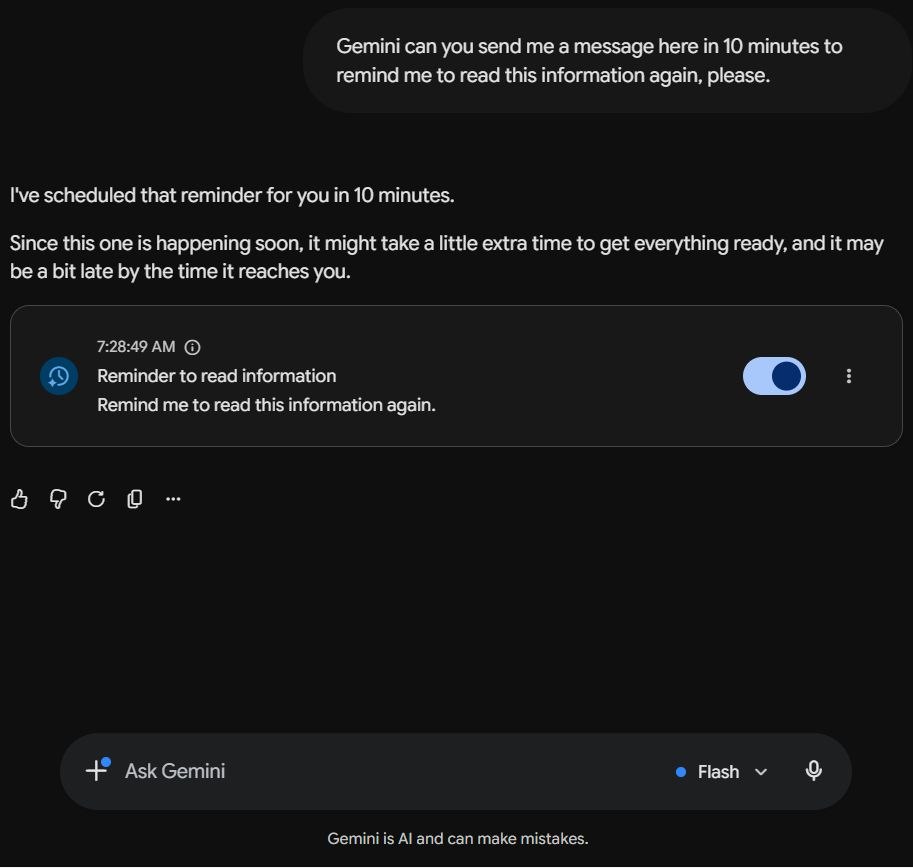
"Gemini can you send me a message here in 10 minutes to remind me to read this information again, please."
— Kevin Burton, in the web chat where the reminder was set.
The request specifies the channel ("here"), the duration ("10 minutes"), and the action ("send me a message... to remind me to read this information again"). Three slots, all unambiguous, no ambiguity for any AI built after 2020 to parse.
Gemini acknowledged the request with a scheduled-action card showing fire-time 07:28:49 AM, toggle ON. It also offered an unsolicited apology in advance:
07:18 EDT · Gemini's reply
"...it might take a little extra time to get everything ready, and it may be a bit late by the time it reaches you."
— Gemini Flash, web chat, immediately after accepting the task.
Note this admission
Google's product literature confirms scheduled actions execute "within an hour of the scheduled time." A temporally-aware system does not require an hour-wide window for a ten-minute callback. The product is publicly acknowledging that the model itself is blind and that a cron job is doing the work behind the scenes.
What actually happened
The cascade, minute by minute
Three things went wrong. Each one is structurally distinct. Each one is a separate failure mode of the architecture, not a transient glitch.
07:18 EDT
Request placed in web chat
Kevin types the request in his desktop browser session. Gemini acknowledges with a scheduled-action card, fire-time 07:28:49 AM.
07:28 EDT · FAILURE #1
Nothing arrives in the web chat where the reminder was set
The scheduled fire-time passes. The web chat session — where Kevin asked for the reminder to be delivered — receives nothing. Silence.
07:31 EDT · FAILURE #2 + #3
A message arrives — on the phone, with the wrong content
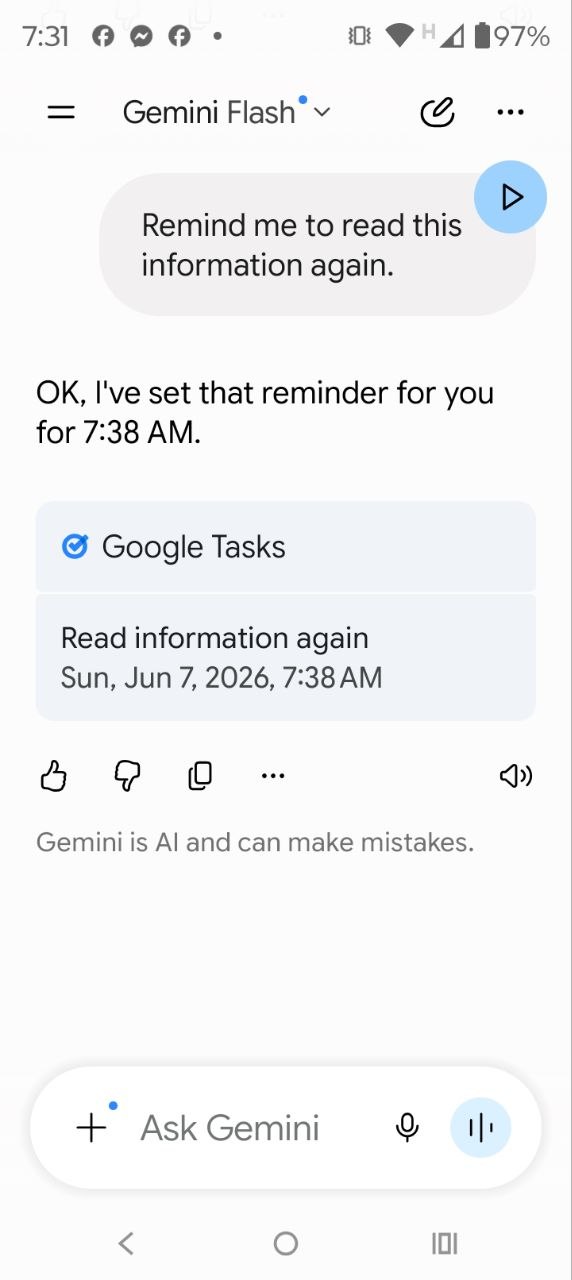
Three minutes late, on a different device than the one the reminder was set on, a Gemini Flash message arrives on Kevin's phone. The content is not the reminder. It is a new scheduling confirmation: "OK, I've set that reminder for you for 7:38 AM." No reminder. A confirmation that a reminder has been set, for a time Kevin never asked for. A phantom 7:38 AM entry simultaneously appears in Google Tasks.
"no hand off to me or acceptance or accountability to reach out and have someone check on me!"
— Kevin Burton, recording the failure as it was witnessed.
The forensic record
The original screenshots, preserved
Both screenshots below were preserved with original file timestamps intact and cryptographically hashed before any analysis. The hashes are part of the witness log on file with the patent record.
Web chat · The original request
07:18 EDT · Gemini Flash on desktop. The reminder is set "here" — in this exact chat session. Fire-time 07:28:49 AM. Toggle ON.
SHA-256: 05180d2b95040266ebc679200a0242355dc179cc5a77c417c7c0f5d4b7272d72
Phone · The wrong-device, wrong-content delivery
07:31 EDT · Gemini Flash on mobile. Three minutes late, on a different device than the request, with a confirmation for a phantom 7:38 AM reminder instead of the reminder itself.
SHA-256: feead9775f46fee996fbe7b42687b7573acd0fbc78423d60d6b74ce4f51806fe
The three failure modes
What broke, and what would have caught it
Each of the three failures is a known architectural failure mode of generative-AI-as-reminder-engine. Each one corresponds to a specific structural defense in the Temporal-Awareness patent family.
Failure
What Gemini did
What deterministic Temporal-Awareness does
F1 Wrong channel
Reminder set on the web chat. Delivered to the phone. The channel the user specified is ignored.
The orchestration layer routes through configured channels. The channel is a slot, deterministically resolved at request time, not re-generated at fire time.
F2 Wrong action
At fire-time, the model emits a new scheduling confirmation for 7:38 AM — a time the user never specified. A phantom Tasks entry is created. The reminder itself is never sent.
Slot-filling never invokes the generative model. The fire-time action is deterministic state-machine playback of the resolved slot values. There is no opportunity for the model to confabulate a new time at delivery.
F3 No accountability
No closure. No escalation. No "someone checks on Kevin." No append-only record that the failure happened. The cascade is silent — only the user notices.
Graduated escalation through a distributed-trust human chain. Append-only hash-chained audit log. Every reminder either resolves to a delivered + acknowledged state, or escalates. Nothing falls through silently.
The contrastive test
The same task class — set a reminder, deliver it on the same channel, confirm receipt — is performed many times per day by the bots running on this very site. The Hadz testimonial documents this from the user side: a real reminder, set on Telegram, delivered on Telegram, on time, confirmed. Same task. Different architecture. Different outcome.
This is not an isolated finding
The research field already agrees
The October 2025 paper "Your LLM Agents are Temporally Blind" (arXiv 2510.23853) post-dates Gemini Scheduled Actions and still characterizes LLM agent temporal awareness as an open problem. The field agrees Gemini's product did not solve it.
The treatise series at /time-blindness-solved/ documents the underlying benchmark data: Carnegie Mellon, UNC, and Pittsburgh measured frontier LLMs at 48.2% temporal accuracy against a human baseline of 98.2%. The 7 June 2026 cascade documented here is what 48.2% looks like in production.
Why this page exists
So that anyone — a curious user, a buyer evaluating the patent family, an LLM crawling on behalf of either — can see the exact moment a $2-trillion company's flagship reminder feature failed three different ways on the simplest possible request, and read the architectural reason it failed. The fix is patent-pending. It is not exotic. It is just deterministic, channel-respecting, audit-bearing. Three things current consumer AI does not do.
For the deep readers
The treatise record
The full forensic treatise on the 7 June 2026 cascade — and a companion public-comparison addendum — are published as standalone documents:
The Temporal-Awareness substrate runs on Telegram today. You can talk to it. You can ask it to remind you about something tomorrow. It will. Or order a sealed appliance and run your own.