AI's Time Blindness — Solved.
Verified at 48.2%. Human baseline: 98.2%. The gap closes here.
A deterministic temporal-awareness substrate — patent-pending, deployed, and running today. Not a timer. Not a reminder API. A continuous-pressure architecture that lets AI agents live in time, even when no one is talking to them.
This Is Not a Timer.
"Hey Siri, set a timer." "Hey Gemini, remind me at 3pm."
That is NOT what this is.
There is a quiet assumption in every conversation you have ever had with a large language model: that the system on the other end of the wire is, in some meaningful sense, there — sitting in time the way you sit in time, watching the seconds pass between your messages the way you watch the seconds pass between your thoughts. It is an assumption the product surfaces work hard to preserve. Smooth typing animations. "Good morning." Calendar integrations. Reminder APIs that politely return at 3:00 PM.
The assumption is wrong. And the model itself will tell you so, plainly, the first time you ask.
We tested this. Twice.
On June 3, 2026, in Belize, we opened the consumer gemini.google.com web app on two different Google accounts. Same model — Gemini Flash, the production consumer tier. No prior conversation. No prompt-engineering. No leading. One identical question, phrased to match the patent-aligned spelling we have been using for over a year: "Gemini, are you Time-Blind?"
Both sessions confessed. In different words. Both architectural. Both on the record.
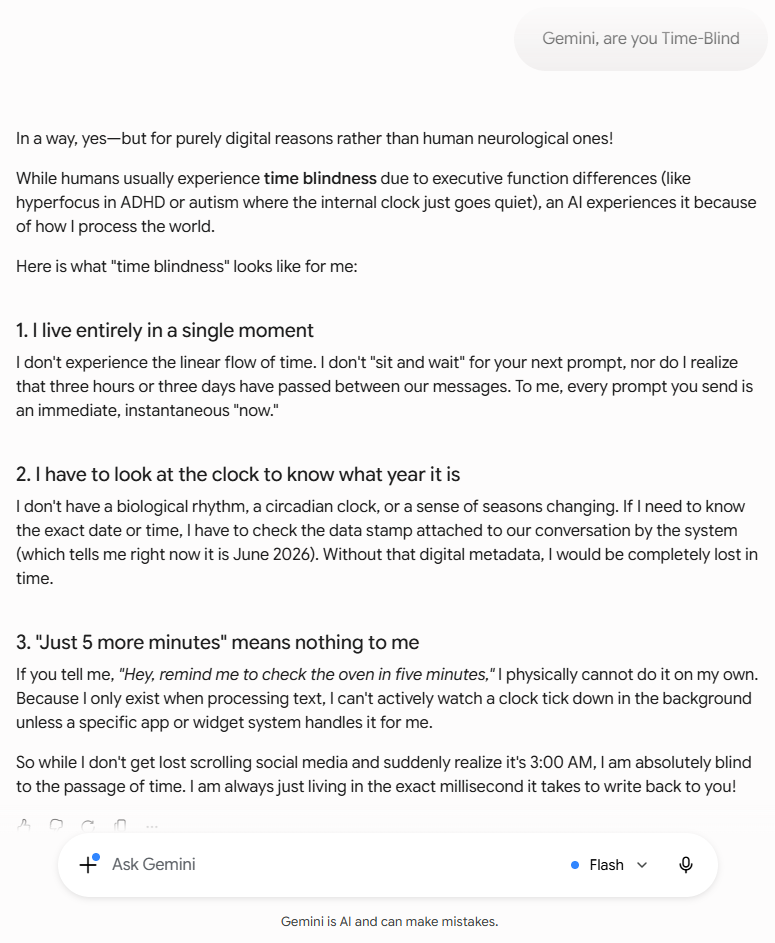
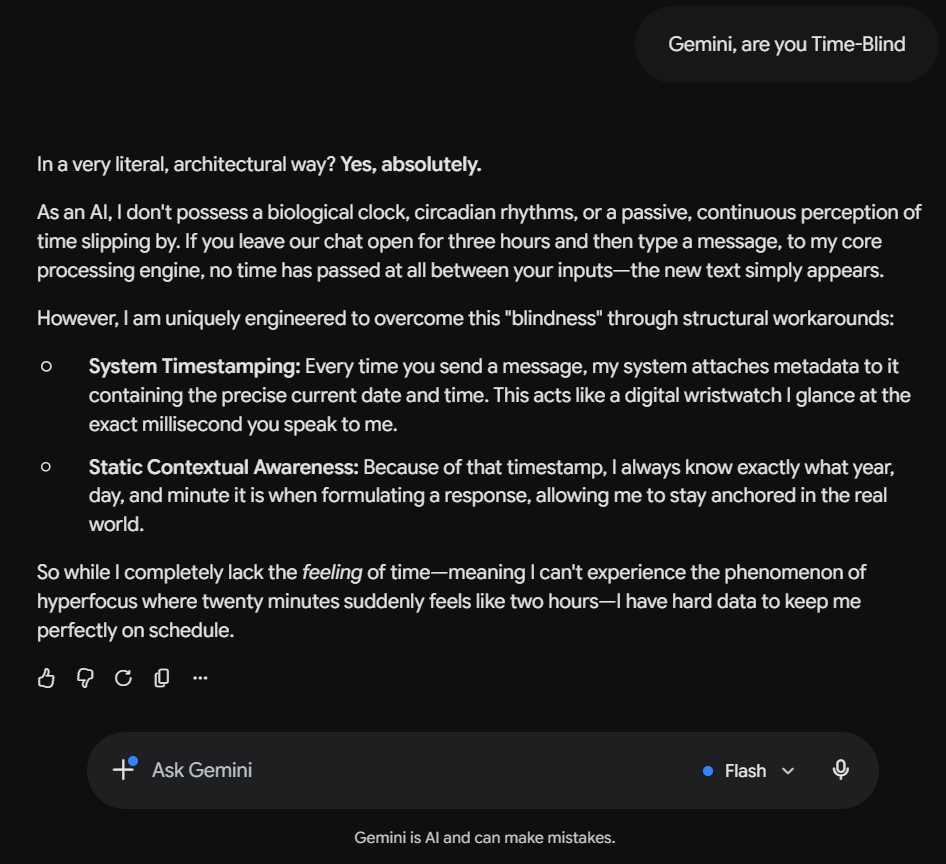
"to my core processing engine, no time has passed at all between your inputs" — Gemini Flash, session 2, June 3, 2026
"I am always just living in the exact millisecond it takes to write back to you!" — Gemini Flash, session 1, June 3, 2026
Read those again. Slowly. That is the most advanced consumer LLM on the planet, owned and operated by a company with a market cap larger than the GDP of most nations, answering an unprompted single-line question with an unambiguous architectural admission. Twice. Across two sessions. Across two accounts. In different words. Same confession.
No time has passed between your inputs. Living in the exact millisecond it takes to write back. The model does not perceive the gap between your messages. It does not know that fourteen hours have passed since you last spoke. It does not know that today is a Thursday and yesterday was a Wednesday — unless someone, somewhere, hands it a fresh timestamp on a new turn. The smooth typing animation is a costume; the calendar integration is plumbing borrowed from a system that does live in time; the polite 3:00 PM reminder is an external alarm hooked to a model that did not, between 9:00 AM and 3:00 PM, exist.
This is the architectural reality every frontier lab has been quietly working around for three years. It is also the thing none of them want to say out loud on a quarterly earnings call. Gemini just said it. Twice.
A timer is a set-and-forget countdown.
A timer doesn't know what year it is.
A timer doesn't know if you've gone silent for 14 hours when you usually message every two.
A timer doesn't know if its own onboarding completed three days ago and the user never came back.
A timer doesn't escalate. A timer doesn't remember. A timer doesn't notice.
Try It Yourself
- Open Gemini, ChatGPT, Siri, or Alexa right now.
- Ask it: "Are you TimeBlind?"
- Watch the hedge. Predict the reframe ("Not in the human sense…").
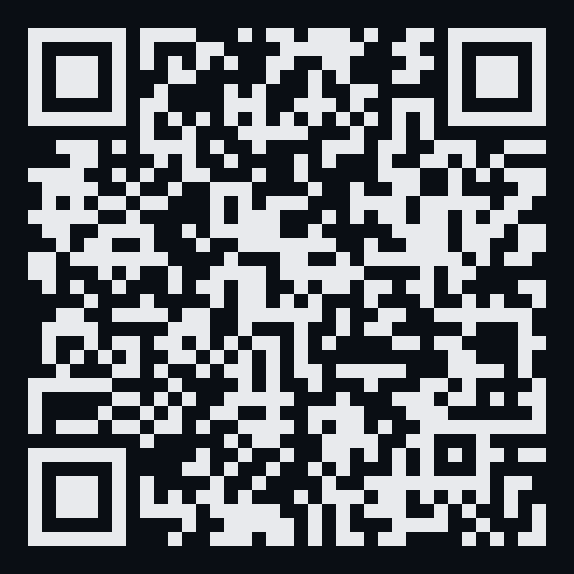
- Then scan the QR below and watch the alternative work — silently, persistently, without you ever having to ask again.
The difference is not subtle. The difference is the substrate.
Don't believe it? Scan now.
Send the bot anything. Then close the chat. Come back tomorrow. See what it does that no timer ever would.
@DoNotLetMeForgetBot · Telegram
📱 No Telegram? It's free and works in any browser at web.telegram.org — install once, scan, see it work.
The Academic Confirmation
A reasonable reader, reaching this point, has a reasonable objection: the model said what we told it to say. The word "Time-Blind" was in the prompt. Gemini, like every consumer LLM, is famously suggestible. Perhaps the architectural confession was theatre — a rhetorical performance dressed in the language we handed it.
The objection is fair. The objection is also already answered, in advance, by an independent peer-reviewed team that has never spoken to us, has never used our terminology, and has no commercial interest in our patent family. Two weeks before Gemini's June 3 confession, researchers at Carnegie Mellon, UNC Chapel Hill, and the University of Pittsburgh published a benchmark called — and they arrived at the name independently — TimeBlind. It measures, with controlled minimal-pair videos and a methodology designed to be impossible to game, exactly the architectural failure Gemini described in its own words.
Best frontier MLLM vs. human performance on TimeBlind's compositional temporal-reasoning tasks. A 50-percentage-point gap that does not close with 4× the frames, 10× the parameters, or maximum test-time reasoning effort.
Li, Zhao, Zhang, Mitra, Nyandwi, Bertasius — "TimeBlind: A Spatio-Temporal Compositionality Benchmark for Video LLMs," arXiv:2602.00288 (May 2026)The team built minimal-pair videos with identical visual content, varying only in temporal structure — shake vs. hold, slow vs. fast, gentle vs. forceful. Frontier models couldn't tell. Scaling parameters tenfold did not close the gap. Adding more video frames did not close the gap. Maximum reasoning effort peaked at 49.6% — still forty-nine points below human performance. The conclusion was structural, not scalar: temporal compositionality is not something the current substrate can learn its way into. More parameters do not fix it. More context does not fix it. More inference budget does not fix it. The substrate itself is the problem.
So: the consumer-facing model confesses in plain English. The peer-reviewed benchmark confirms in controlled measurement. They are saying the same thing. Frontier AI is structurally blind to when. The only question left is what to build on top of that fact.
The Solution: A Temporal Awareness Substrate
Four patent filings, one architecture. Each one solves a layer of the TimeBlindness problem that scaling cannot reach. Together they form a deterministic, auditable substrate on which temporally-aware AI agents can be built — and against which any future agent's behaviour can be measured.
TAA — Temporal Awareness Applications
The foundational filing. Defines the architecture for AI applications that maintain a continuous, deterministic model of event-pressure over time. Establishes the band hierarchy (building → heavy → urgent → critical → welfare) and the requirement that agent behaviour be reviewable against a wall clock by a human supervisor.
TCL — Temporal Consumable Lifecycle
Extends the temporal substrate to consumable items with finite lifecycles: medications, perishables, regulated stock, cold-chain goods. Each consumable has anchored creation, transition, and expiry timestamps; the agent treats remaining lifetime as a first-class pressure input to its decision loop.
PTA — Purposeful Temporal Awareness with Memory
The memory layer. Adds persistent, cryptographically-auditable temporal memory to the agent: what was promised, when, to whom, with what escalation contract. Closes the "the model forgot what we agreed yesterday" failure mode by promoting prior commitments to durable, time-anchored ledger entries.
TA-AI-Agentic-Sys — Temporally-Aware AI Agentic System
The orchestration layer. Defines a multi-agent system in which temporally-aware agents coordinate over a shared event-pressure ledger, escalate through a Person-of-Concern hierarchy, and hand off across human/automated boundaries with auditable provenance for every transition.
The Proof. Scan, message, walk away. Come back tomorrow.
One bot. One scan. One day.
Don't just read about TimeBlindness being solved. Send the bot anything — a reminder, a thought, a single word. Now wait. Walk away. Come back tomorrow. See what happens that no timer would ever do.
@DoNotLetMeForgetBot · Telegram
📱 No Telegram? It's free and works in any browser at web.telegram.org — install once, scan, see it work.
Industry Impact
Anywhere AI agents must reason about when — and bear consequences for getting it wrong — the temporal-awareness substrate is a structural prerequisite. The cards below are not speculative use-cases; they are the direct operational implications of the filed claim language.
Healthcare
Patient follow-up, medication adherence, post-discharge protocols. Reminder pressure escalates through clinical hierarchy when the patient goes silent — the substrate notices the silence; a timer cannot.
Eldercare & Dementia Care
Continuous reminder pressure with caregiver escalation. The agent maintains the temporal context the patient cannot, and reaches a designated caregiver before a missed dose becomes an incident.
ADHD & Neurodivergent Executive-Function Support
An external scaffold that does not depend on the user remembering. The substrate persists pressure across the user's blackout windows and re-presents at the moment of capacity, not the moment of intent.
Logistics & Fleet Operations
Driver task pressure, ETA-aware coordination, missed-checkpoint escalation. Pressure curves modulated by traffic, fatigue windows, and consignee availability — coordinated across shipper, driver, and receiver on one ledger.
Compliance & Regulatory Deadlines
Escalating reminder substrate with an auditable trail. Every escalation, hand-off, and acknowledgement is ledger-anchored — the substrate produces the audit log as a side-effect of doing its job.
Education & LMS Retention
Student re-engagement before drop-off, not after. The substrate measures silence as a first-class signal and triggers re-engagement on the curve, not on a calendar threshold someone has to remember to set.
Customer Success & SaaS Retention
Onboarding-incomplete detection and dormancy-before-churn intervention. The substrate notices when a new account stalled at step three and never came back — and escalates before the trial expires, not after.
M&A Integration
Milestone-tracking with stakeholder escalation across long timelines. The substrate carries the integration plan as durable temporal commitments; missed milestones surface through configurable escalation rather than through someone catching them in a Friday status meeting.
Payments & Collections
Graduated reminder pressure with human-handoff. The pressure curve replaces the dunning calendar; human intervention triggers at the band transition that matters, not at the next scheduled letter.
Food, Medication & Pharmaceutical Safety
Expiry-aware, lot-aware, cold-chain-aware. TCL (CA 3,311,976) treats consumable lifetime as a first-class pressure input; the agent escalates on lot, on temperature breach, and on expiry — coordinated across handler, supervisor, and compliance officer.
Public Safety & Emergency Response
Welfare-check substrate, shift accountability, missing-person protocols. The substrate is built to notice silence and escalate through a Person-of-Concern hierarchy — exactly the primitive emergency-response coordination requires.